Showing posts with label FishBase. Show all posts

21 July 2020

SeaLifeBase at 15: Looking back at its wealth of data


Numbers can speak a lot. 

SeaLifeBase, a biodiversity information system on the world's marine organisms other than fish, started in 2005. 

It's patterned after the well-known FishBase, the world's leading biodiversity information system on all fishes. 

It took a lot of work to make this database possible -- with dozens of staff and hundreds of collaborators around the world.

It's been 15 years since then. 

Time flies, right?

We can now look back and dip into the wealth of data which can only become more important in the years to come.

SeaLifeBase now covers 76,000 marine species (apart from finfish) with 56,000 common names backed up by 36,000+ references. Globally, we now have 300+ collaborators who helped us make available 13,000+ pictures. 

SeaLifeBase and FishBase are freely available.

If you're keen to learn more about non-fish marine organisms, from the charismatic sea turtles down to the fascinating world of meiofauna, be sure to share this resource.


05 April 2018

FishBase and SeaLifeBase sign MoU with World Register of Marine Species (WoRMS)


Databases are rich sources of information, serving not only as learning tools, but a means toward fruitful collaborations and a catapult in advancing scientific research.


This has been the very aim when World Register of Marine Species (WoRMS), FishBase, and SeaLifeBase have officially formed a collaboration last March 2018 to best serve the scientific community.


Last September 2017, the WoRMS Data Management Team attended the 15th International FishBase Symposium in TervurenBelgium. The meeting focused on WoRMS’ underlying database Aphia and its potential use in global, regional and thematic registers, along with LifeWatch Taxonomic Backbone.


The team discussed the existing collaboration between FishBase and WoRMS, wherein FishBase has served as the taxonomic resource for fish names in WoRMS. Building on the ties that have strengthened both databases, the WoRMS team expressed their intention to also document in their database the fish distributions and traits from FishBase.


During the consortium meeting, the team has also seen the potential of FishBase's sister-database, SeaLifeBase—a joint project of the Sea Around Us (University of British Columbia, Vancouver, Canada) and the FishBase Consortium—in providing biological and ecological information of global non-fish species, which can then be maximized for biodiversity and ecosystem studies. WoRMS, in turn, would provide its taxonomic backbone to SeaLifeBase. 

Related links:
http://www.marinespecies.org/news.php?p=show&id=5335
http://www.lifewatch.be/en/news?p=show&id=5335
WoRMS-Q-quatics MOU


29 October 2015

THROWBACK THURSDAY: DR. PAULY IN THE WHITE HOUSE SCIENCE FORUM


Dr. Daniel Pauly at a White House event on citizen science. (Source: Sea Around Us)

We take pride as SeaLifeBase’s Principal Investigator, Dr. Daniel Pauly speaks in the recently held discussion of the Oceans and Coasts session of the “Open Science and Innovation: Of the people, by the people, for the people”, a live-webcast forum of the White House held last September 30, 2015. The event was hosted by the White House Office of Science and Technology Policy (OSTP) and the Domestic Policy Council, having three objectives: (1) to celebrate the successes of citizen science and crowdsourcing; (2) to raise awareness of the benefits these innovative approaches can deliver and; (3) to motivate more Federal agencies and Americans to take advantage of these approaches [1].

In this forum, Dr. Pauly presented FishBase and briefly discussed the efforts of its project staff in the Philippines in gathering and extracting data from vast references in order to make information on all fishes become freely available to the world through the database. FishBase, an online information system founded more than 25 years ago, has grown to become one of the largest global database sources (GSDs) that provides systematic information on all fishes of the world including Etheostoma obama and Teleogramma obamaorum, two species of fish named in honor of President Obama. The database has received almost 50 million hits from over half a million users in a month and has been cited by more than 5000 scientific studies over the past decade, based from the Google scholar [2].

The forum was participated by respected citizen science professionals, researchers, stakeholders from different levels of the government, acadaemia as well as the non-profits and private sectors. It is such an honor for the whole FishBase team to be recognized as a successful science project by the White House. SeaLifeBase and  the whole FishBase Information and Research Group Inc. (FIN) family are very proud of what FishBase, with its founders, Dr. Pauly and Dr. Rainer Froese, have achieved.

Cheers! For future great collaborations that this opportunity might bring.

Watch the complete footage of the event here.

Links to other posts about the event: for Sea Around Us and for FishBase.

______________________________

[1] Kalil, T. and D. Wilkinson.  Accelerating Citizen Science and Crowdsourcing to Address Societal andScientific Challenges. Published on September 30, 2015. [Accessed 10/22/2015].

[2] The FishBase Project Facebook page. Coming Soon: FishBase in the White House! Published on September 28, 2015.  [Accessed 10/22/2015].

Written by:


14 August 2015

13th Annual FishBase Symposium centers on harnessing global information databases for teaching and research


For more than a decade now, the FishBase Symposium is being held in tandem with the FishBase Consortium Annual Meeting. This year, the 13th Annual Symposium will be celebrating the 25th year of FishBase and 10th year of SeaLifeBase.

The annual FishBase Symposium will be held here in the Philippines in Los Baños from September 1 to 4, with FishBase Information Research Group, Inc. (FIN) as the host. The event is generously sponsored by Bureau of Fisheries and Aquatic Resources (BFAR), International Rice Research Institute (IRRI), Philippine Statistics Authority (PSA), Bureau of Agricultural Research (BAR), Philippine Council for Agriculture, Aquatic and Natural Resources Research and Developmet (PCAARDD) , Oceana, WorldFish, SEARCA, Biodiversity Management Bureau, Asian Development Bank, Asean Centre for Biodiversity, Manila Ocean Park,  Mundus maris, World Wildlife Fund, and Conservation International - Philippines. This year’s theme, “FishBase and SeaLifeBase for Teaching and Research in Aquatic Science” will focus on how FishBase and SeaLifeBase can be utilized as powerful tools in teaching and research in the Philippines as well as increasing public awareness on the databases, promoting their various applications in sustainable fisheries management, biodiversity conservation and environmental protection.

FIN is guided scientifically by a Consortium of 10 international members, i.e. three European natural history museums (Swedish Museum of Natural History [Stockholm, Sweden], Royal Museum for Central Africa [Tervuren, Belgium], and Muséum National d'Histoire Naturelle [Paris, France]); four universities (Helmholtz Centre for Ocean Research Kiel [Kiel, Germany], Fisheries Centre, University of British Columbia [Vancouver, Canada], and Aristotle University of Thessaloniki [Thessaloniki, Greece], Universidade Federal de Sergipe [Sergipe, Brazil]; and three non-government organisations (Food and Agriculture Organization of the United Nations [Rome, Italy], WorldFish [Penang, Malaysia], and Chinese Academy of Fishery Sciences [Beijing, China]) 
Attending this four-day event at IRRI, College, Los Baños, Laguna are invited speakers from local universities and research institutions, representatives of partner institutions, FishBase Consortium members themselves, and students from universities and secondary schools in the Philippines. 

Among the notable guests is Dr. Daniel Pauly, a world-renowned fisheries biologist. He is the co-proponent (alongside Dr. Rainer Froese) of FishBase, the highly successful database on all fishes of the world and the Principal Investigator of SeaLifeBase, a flourishing complementary database which documents all non-fish marine organisms. An outlier and a true hero in the fisheries sector, he has bravely filled the void in world’s fisheries. While most conform in regulatory agencies with skewed systems, he and his colleagues have looked at the larger picture, repeatedly being upfront on reporting that fish stocks are plummeting worldwide. He stressed that a considerable reduction in global fishing and a firm stand on “no take” zones are crucial for fisheries to thrive. His contributions to fisheries are insurmountable. He co-developed concepts, methods and software which are documented in over 500 scientific and general-interest publications and used by ocean experts throughout the world. With so much on his plate, he even teaches an array of courses at the Fisheries Centre and Zoology, University of British Columbia and handles graduate students in four languages on five continents. No wonder his career has been highly commended in various profiles like Nature and New York Times, to name a few. Recently he was invited in TedXSydney wherein he unfolded the obvious gap between the reported global catch and the much higher reconstructed global catch. Since 1999, he has served as the Principal Investigator of the Sea Around Us, working towards mitigating the impacts of fisheries on the world’s marine ecosystems.

The 13th Annual FishBase Symposium will be held on September 1, and will focus on paper presentations both international and local. Dr. Daniel Pauly will give the key note address with the theme “FishBase: an improbable success, and what it inspired.” Dr. Cornelia Nauen of Mundus Maris, Belgium will lead the inspirational talk. FishBase Consortium members who themselves are presentors will share their experiences and insights in using FishBase to supplement teaching and research activities. They are Dr. Rainer Froese, FishBase Consortium Coordinator, Helmholtz Center for Ocean Research, Germany; Dr. Nicolas Bailly, Helenic Centre for Marine Research, Greece; Dr. Jos Snoeks, Musée Royal de l'Afrique Centrale, Belgium; Dr. Kosta Stergiou, Aristotle University of Thessaloniki, Greece; Dr. Kátia Freire, Universidade Federal de Sergipe, Brazil; Dr. Markus Skyttner, Swedish Museum of Natural History, Sweden; Dr. Fumito Muto, Tokai University, Japan; Dr. Mathieu Colleter, University of British Columbia, Canada; and Ms. Regina Bacalso, ECOFISH-USAID. 

Local presentors will come from five distinguished research institutions and two state universities. They will talk about their work and how FishBase and SeaLifeBase have contributed or can contribute to teaching and research. Speakers are Dr. Reiner Wassmann, International Rice Research Institute; Dr. Rex Montebon, Conservation International-Philippines; Dr. Adelaida Palma, NFRDI-BFAR; Mr. Christian Elloran, ASEAN Centre for Biodiversity; Mr. Patrick Co, World Wildlife Fund Philippines; Dr. Benjamin Vallejo, Jr., UP Diliman; and Dr. Asuncion de Guzman, Mindanao State University Naawan. Dr. Maria Lourdes Palomares, SeaLifeBase Project coordinator, will conclude the symposium. 

Other anniversary celebration activities from September 1 to 4 include a poster exhibit of FishBase and SeaLifebBase, a book-giving activity to local libraries, students’ hands-on orientation on FishBase and SeaLifeBase, and an art competition – poster-making and digital photo contests – expressing underwater relationships and connections. A workshop on “New Technology for small scale fisheries data collection” will be sponsored by Oceana on September 4 and will be led by Dr. Stephen Box of Smithsonian Institution, USA. 

This anniversary event is also a tribute to honor the donors, partners and collaborators who have extended their support through the years to provide, free of charge to the public, these comprehensive information systems with key data on all aquatic organisms of the world.


08 May 2013

FishBase to be featured at Science World's Meet a Community Scientist Event on 11-12 May


Dr. Deng Palomares
SeaLifeBase Project Coordinator
Science World in Vancouver, Canada is guesting scientists and researchers to talk to public audiences about science through the Community Scientist Initiative (CSI)

SeaLifeBase Project Coordinator Dr. Deng Palomares will be one of these volunteer community scientists and she will be talking about fishes and FishBase. So if you're around the area, join her in the 4-hour event of interactive discussions on May 11-12.

18 October 2012

Announcement from FIN Executive Director Mary Ann Bimbao


On September 2012, SeaLifeBase Project Coordinator M.L. Deng Palomares accepted the position of Associate Scientific Director for the FishBase Information & Research Group, Inc.(FIN) which manages both FishBase and SeaLifeBase projects.
          
Deng joins Nicolas Bailly who was appointed as FIN's Scientific Director in January 2011, with the latter and the former to lead and manage FishBase and SeaLifeBase, respectively. Her appointment will balance the relationship and work between the two databases, whose programs will further be well coordinated for upcoming projects particularly directed towards an ecosystem approach.
           
Nicolas and Deng are on secondment arrangement from WorldFish and UBC Fisheries Centre, respectively.

15 October 2012

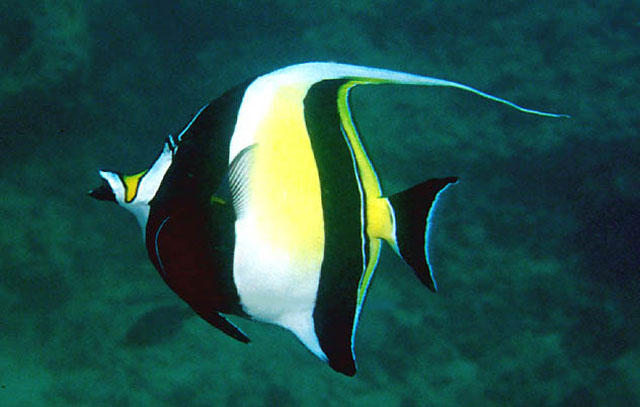
Moorish Idol


Mohammedans of Africa and Asia venerated this fish, probably due to its long sickle-form dorsal fin, and hence its name, Moorish idol [1].

Photo by Richard Field

Its Latin name, Zanclus cornutus, can be literally translated as ‘horned back’: Zanclus, from Greek agklino, i.e., ‘to be on one’s back’[2], and cornutus from Latin, i.e., horned[3].

The name Zanclus was applied to a person, the first king of Messina (Sicily), who gave his name to the town of Zancle[4]. Which makes Gill of Finding Nemo a venerated Sicilian crowned prince!


Ciao, Principe Gill!


[1] Robins, C.R., Bailey, R.M., Bond, C.E., Brooker, J.R., Lachner, E.A., Lea, R.N., Scott, W.B. 1991. World fishes important to North Americans. Exclusive of species from the continental waters of the United States and Canada. Am. Fish. Soc. Spec. Publ. (21):243 p.
[2] Romero, P., 2002. An etymological dictionary of taxonomy. Madrid, unpublished. See http://www.fishbase.org/references/FBRefSummary.php?ID=45335
[4] http://www.ancientlibrary.com/smith-bio/3643.html.


Written by:
Maria Lourdes 'Deng' Palomares
Project Coordinator
The SeaLifeBase Project

12 September 2012

FishBase and SeaLifeBase in Mundus Maris website

FishBase and the SeaLifeBase are featured in the Biodiversity section of the Mundus Maris website.

FishBase and SeaLifeBase in Mundus Maris

Mundus Maris is a group of scientists, artists, educators, concerned parents from different regions of the world to provide scientific and relevant indigenous knowledge and encourage artistic expression about the marine environment to promote its restoration, conservation and sustainable use.


Posted by:
Lealde Pacres-Urriquia
Research Assistant
The SeaLifeBase Project

22 June 2012

FishBase and SeaLifeBase: an overlap?


Earlier this week, one of our Facebook fans wrote on our wall and asked:
  
Does SeaLifeBase overlap with FishBase?
   
First, let us just say that it is always exciting to hear from our users and "fans".  Second, that this is a very good question.  After all, 1) our names sound alike, 2) our websites are nearly identicaland 3) we generally provide the same type of data (distribution and biology).
  
But, the answer to that question is: No, it does not.

Overlap?

While FishBase covers only fishes, SeaLifeBase assures data for the "non-fishes": whales, dolphins, turtles, sea birds, snakes, crabs, lobsters, sea shells, shrimps, sea cucumbers, starfishes, sponges and all other marine organisms that are not fish.  FishBase, with its 22 years of existence/experience, was used by SeaLifeBase as the shell and structure in delivering information for non-fishes to the public.
   
SeaLifeBase aspires to create and maintain a global information system that provides vital information for non-fish marine organisms --- just as what FishBase has achieved for fishes.  SeaLifeBase is still young at 6 years of existence, and with more than 200,000 non-fish species, we have a long way to go.  And we are going, slowly but surely.

Written by:
Lealde Pacres-Urriquia
Research Assistant
The SeaLifeBase Project

Image manipulation by:
Jeniffer Espedido
Research Assistant
The SeaLifeBase Project